

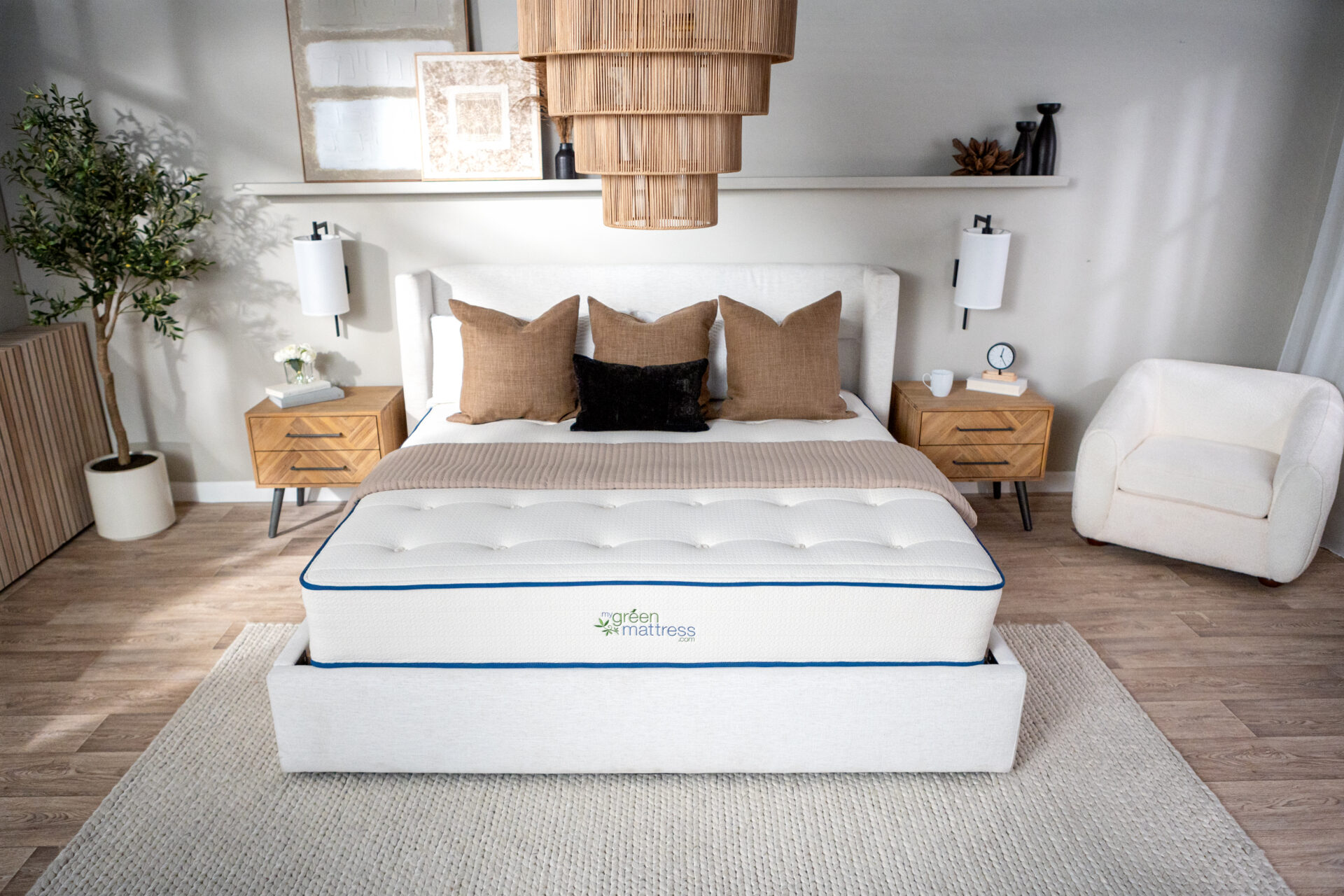
Memory foam is everywhere. It’s in the mattresses sold by the biggest brands in the world, rolled up in boxes and shipped to doorsteps by the millions. It dominates search results, sleep influencer roundups, and mattress comparison sites.
But we don’t make one.
It’s a deliberate choice, and we think it’s worth explaining.
What Memory Foam Actually Is
Memory foam — technically called viscoelastic polyurethane foam — was originally developed by NASA in the 1960s for aircraft seat cushions. It’s made by combining petroleum-derived polyols and isocyanates, which react together to create the characteristic slow-response foam structure.
Various additives go in too: catalysts, surfactants, blowing agents, and others that shape how the foam performs and how long it holds together.
The end result is a material that contours to the body under heat and pressure, then slowly returns to its original shape when that pressure is removed. That’s the “memory” part. It’s genuinely effective at conforming to body shape, and it does a good job at motion isolation. There are real reasons it took over the market.
There are also real reasons we chose something else.
The Problems We Couldn’t Get Past
It’s a petrochemical product.
There’s no version of memory foam that isn’t. The isocyanates used in production (typically TDI or MDI) are industrial chemicals, and polyurethane is a petroleum-based compound. This matters to us because we believe the materials you sleep on for eight hours a night deserve the same scrutiny as the food you eat or the air you breathe.
It off-gasses.
New memory foam mattresses release volatile organic compounds (VOCs) — that distinctive chemical smell when you unbox one is the most obvious sign. The industry standard response is to tell customers to air the mattress out for a few days before sleeping on it. We find that unsatisfying. Our position is that a mattress shouldn’t require airing out.
It needs chemical flame retardants.
Polyurethane foam is highly flammable, which means manufacturers have to apply flame retardant treatments to meet federal safety standards. Some of those chemicals — particularly older formulations containing PBDEs — have been linked to health concerns. Even as the industry moves toward less toxic alternatives, the fundamental problem remains: you need the flame retardant because the base material is so combustible.
It traps heat.
The dense, closed-cell structure of memory foam doesn’t breathe. Body heat accumulates at the surface, which is why hot sleepers almost universally report problems with foam mattresses. Gel infusions help somewhat, but they address the symptom rather than the cause.
It loses support.
Memory foam loses its support properties over time — typically beginning around year six or seven. A mattress that stops supporting your spine correctly isn’t just uncomfortable; it’s quietly working against you every night.
It is a Landfill Problem.
When discarded in landfills, memory foam can remain intact for decades or even centuries, taking up valuable landfill space and contributing to long-term waste accumulation. Because it is derived from fossil fuels, the production and disposal of memory foam also have environmental impacts, including greenhouse gas emissions and the consumption of nonrenewable resources.
What We Built Instead
My Green Mattress was founded in 2007 by Tim Masters, a third-generation mattress craftsman in La Grange, Illinois. Tim had been making mattresses for decades when his daughter Emily was diagnosed with eczema and allergies.
He started looking very carefully at what was in the products his family was sleeping on, and what he found changed the direction of the business.
What followed wasn’t a pivot toward trendier materials, it was a return to something older: organic cotton, organic wool, and organic latex — materials that have been used in quality mattresses for generations, before petrochemicals made foam cheap and abundant.
Organic Dunlop latex comes from the sap of rubber trees. It’s biodegradable, durable, and responsive in a way that’s fundamentally different from memory foam — it contours to the body while gently pushing back, rather than slowly enveloping it. It maintains its support properties for 15 to 20 years. It breathes. And it doesn’t require any chemical treatments to be safe.
Organic wool, quilted into every MGM mattress cover, is a natural flame retardant. It’s why we don’t need to spray our mattresses with anything. Wool chars rather than ignites — it’s genuinely effective fire protection that’s been used for centuries, with no chemical processing required.
Pocketed coils provide the structural support layer, and ours are built with added lumbar support, manufactured in-house and proprietary to My Green Mattress. Every mattress is hand-tufted — without adhesives — in our GOTS and GOLS certified organic factory. Each one is made to order.
This Isn’t a Critique of Everyone Who Buys Memory Foam
Memory foam mattresses aren’t dangerous in any acute sense. Millions of people sleep on them without noticing anything wrong. The industry has made real progress on reducing VOC levels, and certifications like CertiPUR-US set meaningful minimums.
But minimums aren’t what we’re after. We’re after the best materials available, built the right way, with nothing in there that doesn’t need to be. That standard rules out polyurethane foam — not because it’s catastrophically harmful, but because there’s a better option and we know how to build a better bed with it.
Some companies can’t make that claim honestly. We can. So we do.
The Kiwi, Natural Escape and Pure Eco Organic Kids mattresses contain no memory foam, no polyurethane, no chemical flame retardants, and no fiberglass. They’re GOTS certified, GOLS certified, GREENGUARD Gold certified, and MADE SAFE® certified — and they come with a 365-night sleep trial and a 20-year warranty.
You have a year to decide if you notice the difference. Most people do.