

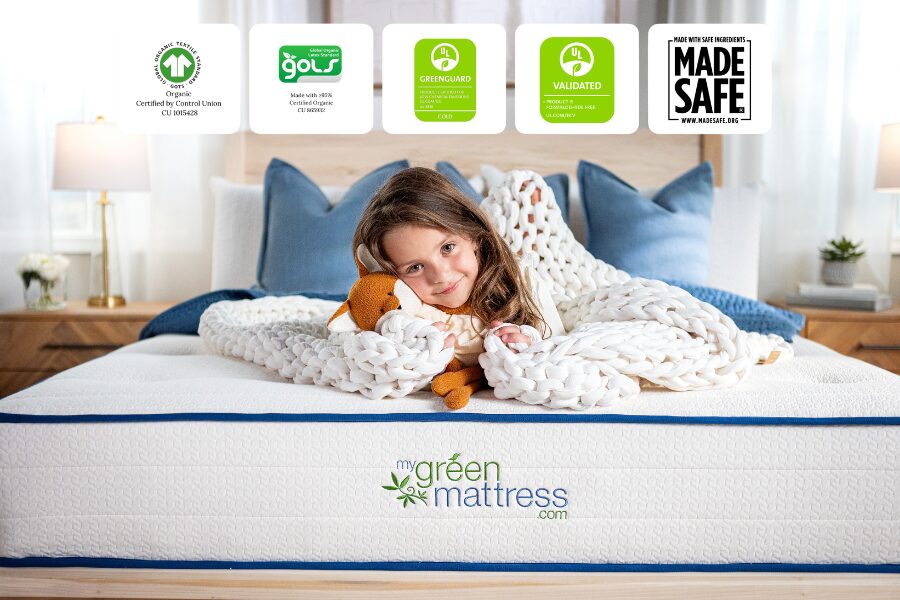
If you’ve spent any time shopping for a mattress lately, you’ve probably noticed something: every brand has certifications. They’re displayed prominently on websites, printed on tags, and listed in bullet points on every product page. Some brands carry two or three. Others list eight or ten.
The problem is that these certifications test for very different things — and brands know that most shoppers can’t tell them apart. A certification that verifies one component of a foam layer gets displayed alongside one that covers the entire supply chain, and they look equally official on the page.
This post decodes the certifications you’ll actually encounter, explains what each one tests and what it doesn’t, and gives you a clear picture of what a truly certified organic mattress looks like.
The Two That Matter Most for Organic Claims
GOTS (Global Organic Textile Standard)
GOTS is the most rigorous certification for organic textiles and the one hardest to fake, because it covers the entire supply chain, not just the end product.
To earn GOTS certification, a textile must contain a minimum of 95% certified organic fibers for the highest grade (“organic”) or at least 70% for the secondary grade (“made with organic materials”). But organic fiber content is just the starting point. GOTS also governs how those materials are processed, manufactured, packaged, labeled, and distributed — including strict limits on which chemicals can be used at any stage of production. The factory itself must be certified, not just the material.
This last point matters. A brand can source organic cotton and then process it with prohibited chemicals before it reaches the finished mattress. GOTS closes that loophole by auditing the entire chain from farm to factory. Third-party inspectors verify compliance at every step.
For mattresses, GOTS covers the organic cotton and wool — the cover fabric, quilting, and any textile filling materials.
What GOTS doesn’t cover: Latex. That’s what GOLS is for.
GOLS (Global Organic Latex Standard)
GOLS is to latex what GOTS is to textiles. It’s the only globally recognized standard for organic latex, and it’s administered by Control Union Certifications — the same independent body that certifies MGM’s factory.
To carry the GOLS label, a latex product must contain at least 95% certified organic latex by weight, harvested from organic rubber plantations. GOLS also governs emissions, chemical content, environmental practices, and labor standards throughout the supply chain. Like GOTS, it uses transaction certificates to trace materials from the plantation to the finished product.
This is the certification to look for whenever a brand claims their latex is “organic.” Without GOLS, that claim is unverified marketing language.
What GOLS doesn’t cover: Textile materials (cotton, wool). You need both GOLS and GOTS for a fully certified organic mattress.
The Ones That Test for Chemical Safety
GREENGUARD Gold
GREENGUARD Gold is issued by UL Solutions and tests the finished mattress for chemical emissions — specifically volatile organic compounds (VOCs) — in conditions designed to simulate a real bedroom environment.
A key distinction: GREENGUARD Gold tests what comes out of the mattress into the air you breathe, not what’s inside it. It applies the most stringent thresholds in the GREENGUARD program, with formaldehyde limits dramatically stricter than the basic GREENGUARD certification — and stricter than outdoor air in many urban areas. It also tests for phthalates, which the standard GREENGUARD certification does not.
GREENGUARD Gold is specifically designed for products used in environments with children and other sensitive populations. It’s a meaningful, independent certification for indoor air quality.
What it doesn’t cover: Whether the materials inside are organically sourced. A mattress made entirely from synthetic foam and chemical treatments can earn GREENGUARD Gold if its emissions test low enough. It tells you how much the mattress off-gasses; it doesn’t tell you what it’s made of.
MADE SAFE®
MADE SAFE takes a different approach. Rather than testing emissions, it screens the ingredients of the finished product against a restricted list of more than 6,500 known or potentially hazardous substances — including carcinogens, endocrine disruptors, neurotoxins, and chemicals harmful to ecosystems.
Where GREENGUARD Gold answers “how much is coming off this mattress into the air,” MADE SAFE answers “does this mattress contain anything we know to be harmful at all?” The certifications are complementary — each covers an exposure pathway the other doesn’t.
What it doesn’t cover: Whether materials are organically sourced, or how they were grown and processed.
OEKO-TEX Standard 100
OEKO-TEX Standard 100 tests textile products and their components for more than 1,000 harmful substances — including pesticide residues, heavy metals, formaldehyde, and phthalates. Every individual component of the finished product must pass: the cover fabric, the quilting, the latex layers, the stitching thread.
OEKO-TEX uses a four-tier product class system, with Class I being the strictest — reserved for products intended for babies and children up to 36 months. MGM’s latex is OEKO-TEX certified, and the wool in their Natural Escape is OEKO-TEX certified as well.
What it doesn’t cover: Organic status. OEKO-TEX Standard 100 verifies that materials are free from harmful substances; it does not verify that they were grown organically. A non-organic textile can earn OEKO-TEX Standard 100 certification.
The One That Only Covers Foam
CertiPUR-US®
CertiPUR-US is a foam certification program established in 2008 and administered by the Alliance for Flexible Polyurethane Foam — the trade association representing the polyurethane foam manufacturing industry. It was created to address substandard imported foams containing banned substances, and it does that job: CertiPUR-US certified foam has been independently tested to exclude certain harmful chemicals, including ozone depleters, heavy metals, formaldehyde, and specific flame retardants.
However, there are important limitations to understand.
First: CertiPUR-US certifies foam only — specifically flexible polyurethane foam. It says nothing about any other component of the mattress: the cover fabric, the wool, the coils, the adhesives, the flame barrier. When a mattress brand displays the CertiPUR-US logo, it means the foam inside passed this standard. Everything else is uncertified by this program.
Second: CertiPUR-US does not certify that a mattress is organic, natural, or free of polyurethane foam. It certifies that the polyurethane foam present meets a baseline safety standard. The base material is still a petroleum-derived synthetic product.
Third: The program is administered by an industry trade group, which means the standards are set by foam manufacturers rather than an independent body — a structural difference from GOTS, GOLS, GREENGUARD Gold, and MADE SAFE, all of which are administered by independent third parties.
CertiPUR-US is a meaningful baseline for any mattress that contains conventional foam. You won’t encounter it on My Green Mattress products, because MGM doesn’t use polyurethane foam.
What My Green Mattress Holds and Why It Matters
MGM’s certifications:
- GOTS — covering organic cotton and wool, factory-certified through Control Union
- GOLS — covering organic Dunlop latex, factory-certified through Control Union
- GREENGUARD Gold — finished mattress emissions testing by UL Labs
- MADE SAFE® — screened against 6,500+ known or potentially hazardous substances
- OEKO-TEX — on latex and wool components
- Formaldehyde-Free Verification from UL Labs
The critical detail in MGM’s certification picture is the factory certification. MGM holds GOTS and GOLS organic factory certification from Control Union — meaning the certifications extend to how materials are handled, stored, and assembled in their La Grange, Illinois facility. The supply chain is traceable from the organic rubber plantation and the organic cotton farm to the finished mattress on your doorstep.
A brand can display GOTS or GOLS logos by using certified materials purchased from a certified supplier — without holding factory certification themselves. MGM holds both the material certifications and the factory certification. Every mattress tag includes traceability numbers linking back to the specific certified materials used in that mattress.
How to Read a Brand’s Certification Claims
A few questions worth asking when evaluating any mattress brand’s certification claims:
Is the finished mattress certified, or just the materials?
There’s a difference between “this cotton is GOTS certified” and “this mattress is GOTS certified.” The former is easier to achieve. The latter means the assembled product was verified, not just a component.
Is the factory certified?
Material certifications can be purchased, but our factory certifications require auditing the entire production process, including how materials are stored, how equipment is cleaned, and how the mattress is assembled.
Does the brand display verifiable certificate numbers?
MGM lists certificate numbers (e.g., CU 1015428 for GOTS, CU 865932 for GOLS) that can be independently verified through the certifying body’s public database. If a brand can’t point you to verifiable documentation, the claims are harder to trust.
Does the certification cover the right material?
CertiPUR-US on a latex mattress means nothing — CertiPUR-US doesn’t apply to latex. OEKO-TEX on a cover fabric doesn’t tell you about the foam core.
Certifications are only useful if you know what they’re measuring. The most reassuring marketing phrase on a mattress website is worth less than a verifiable certificate number from an independent third party.
My Green Mattress publishes all of theirs. You can verify them here.